Review at the last useful moment.
FSRS-6 estimates when each word is about to slip and schedules the review just before it does — so you do fewer and remember more. In Advanced Mode it fits itself to your memory patterns.
If practice feels frictionless, it usually is. Tongueforge makes review slightly harder on purpose so recall gets stronger, not just faster.
Every card asks you to produce the answer. Shows exactly what you missed—down to a single character. The correction teaches instead of just marking wrong.
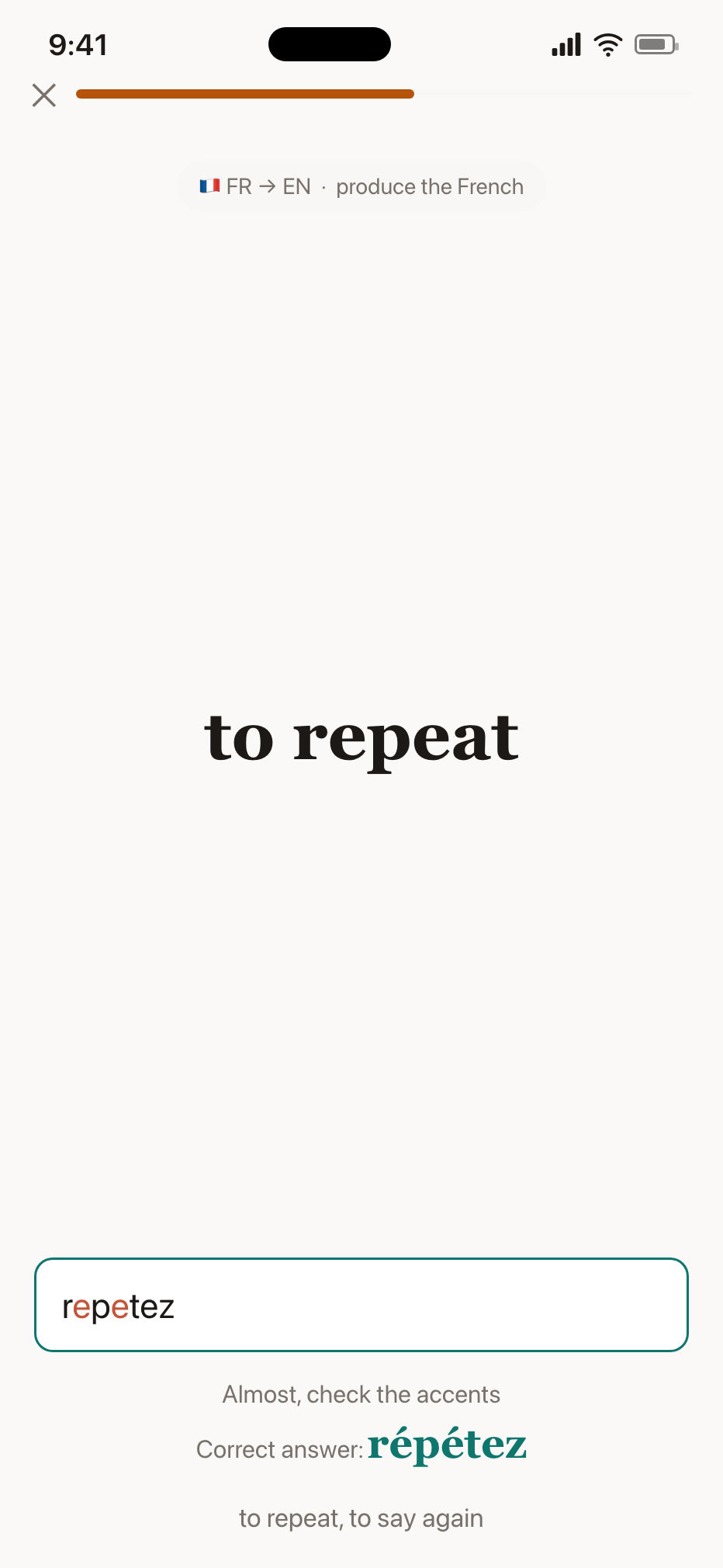
Each choice is there to improve long-term retention, transfer, and diagnostic clarity rather than make the session feel easy in the moment.
FSRS-6 estimates when each word is about to slip and schedules the review just before it does — so you do fewer and remember more. In Advanced Mode it fits itself to your memory patterns.
Producing beats recognizing. A character-level diff shows exactly what you missed. The app knows the difference between a typo, a missed accent, and a forgotten word—so a slip never costs a memory.
Context helps you understand a word, but it's retrieving the word that makes it stick. So Tongueforge doesn't just show vocabulary in sentences—it makes you produce it inside cloze lines and example sentences, then weaves reading passages in so it resurfaces in the wild.
Production practice transfers to comprehension more reliably than comprehension transfers back to production. Tongueforge auto-generates reverse cards and tracks each direction separately, exposing the words you recognize but still cannot say.
Blocked drills feel smooth because the answer pattern repeats; interleaving forces you to discriminate. Tongueforge mixes nearby conjugation targets and makes you identify the tense from context before producing the form.
Focused listening practice can retrain an adult ear to hear the sounds of a new language. "Train your ear" plays a passage, asks a question, then reveals the text for read-along replay. Listening first, reading to consolidate.
As a card matures, Tongueforge automatically pushes it from recognition to cued recall to typed production to listening. Easy items stay fast, while important ones become demanding at the stage where that extra effort pays off.
Generic red crosses don't teach much. Tongueforge names the specific mismatch: "Almost, check the accents" or "Almost, mind the apostrophe." Then you type the correct form once. Producing the fix is what makes it stick. More like a tutor than a buzzer.
These studies established the learning science the method is built on. They weren't run on Tongueforge—no app can borrow their results as proof it works. We link them so you can check the reasoning yourself.
The method is there to tighten recall, surface production gaps, and make every review minute carry more weight. The rest of the product is built around that same constraint.